
 Why Risk Assessment Belongs at the Foundation of Your Safety Management System
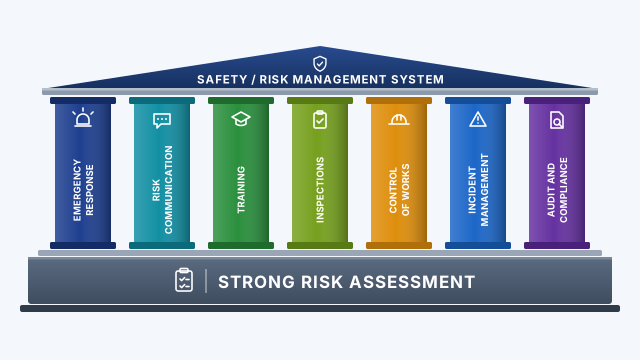
Somewhere in your organisation there's a risk assessment with a line like this: hydrocarbon release from a flange during compressor maintenance, leading to fire. It was identified, rated and signed off. Then it was filed.
That line is a valuable piece of information the organisation owns. It describes how people could get hurt, what would cause it and what stops it. Yet in most companies it is used once, to get the job approved, and never looked at again.
That is how risk assessment usually works. A manager needs one before an activity starts. A contractor needs one before mobilising. An auditor asks to see them. So they get completed, signed, filed and forgotten.
This misses the point. A strong risk assessment shouldn't be the last document produced before work begins. It should be one of the main sources of information the organisation is run from. Risk assess everything properly, and your risk assessments become the foundation of your entire safety management system.
Compliance Is the Floor, Not the Point
Risk assessment slides into box-ticking easily. The objective quietly shifts from understanding risk to proving a document exists. A document can satisfy a requirement and still tell management almost nothing about how the operation could fail. A meaningful assessment answers harder questions:
- What can go wrong, and how can it happen?
- Which controls prevent it, and which of those are critical?
- What happens if those controls fail?
- What do people need to know to do the work safely?
- What must the organisation be ready to do if it goes wrong anyway?
Answer those consistently and you no longer have a pile of completed forms. You have a map of how the organisation can fail, and how each failure is controlled.
Follow One Scenario Through the System
Here's what that looks like in practice. Take the flange release from the opening and follow it out of the risk assessment.
The assessment for the compressor maintenance job captures the scenario. The cause: a flange broken on a line that wasn't fully isolated, depressurised and purged. The consequence: a gas release that finds an ignition source, with people working nearby. The barriers: positive isolation, depressurising and purging, gas testing before breaking containment, control of ignition sources, fixed gas detection and emergency shutdown.
Now watch where that one scenario goes.
| Part of the system | What the flange release scenario gives it |
|---|---|
| Control of work | Isolation, depressurising and gas testing become hold points in the procedure and conditions on the permit |
| Training and competency | Whoever verifies the isolation or performs the gas test needs a proven competency, not just a course on the matrix |
| Risk communication | The toolbox talk before the job covers this release and its barriers, not a generic list of hazards |
| Emergency response | A gas release and fire at the compressor becomes a drill scenario, with shutdown and muster tested against it |
| Non-conformances | A gas detector found out of calibration is ranked against the release it is meant to detect |
| Audit and compliance | Auditors check that isolations are verified and gas tests recorded, because those are the barriers that matter here |
| Incident investigation | If a release happens, the team starts from which barrier was meant to stop it, and why it didn't |
One line in one assessment. Seven parts of the safety management system, all pointing at the same scenario and the same barriers. That is what it means for risk assessment to be the foundation.
Two of those links change behaviour more than the rest.
Investigations get a baseline. Instead of starting from a blank page, the team compares what happened with what the organisation believed. Was the scenario identified? Did a barrier fail, was it missing, or did it only exist on paper? Or was the scenario never identified at all? Each answer points to a different fix, and each one improves what the organisation knows about its risk, not just its record of one event.
Non-conformances get a priority. The out-of-calibration detector stops being one more open item on the corrective action register. It is a missing barrier on a fire scenario, and that changes the question management asks.
Not "how quickly can we close this action?" but "what risk does this open item create, and how important is it?"
Now Risk Assess Everything
That was one scenario on one job. If risk assessment only happens before particular jobs, its value stops there. Assess the operation systematically and the same connections exist everywhere:
- Every facility, plant section and significant piece of equipment
- Every process, activity and task
- Every interface between departments and contractors
- Every flow of people, materials, energy, information and hazardous substances
- Every significant change
From Filing Cabinet to Connected Risk Intelligence
Most safety management systems don't work like the flange example. The organisation has risk assessments, emergency plans, procedures, training matrices, inspection programmes, incident reports and corrective action registers, each owned by a different team. Thousands of documents, with very little connection between them. The result is duplication, inconsistency and knowledge that walks out the door when people do.
The better approach starts from risk and lets it flow outward. The hazard leads to scenarios. The scenarios reveal consequences. The consequences define the barriers. The barriers then shape procedures, training, emergency response, inspections, assurance and corrective actions.
It also changes how management decides. Which equipment gets repaired first, which barriers need attention, who needs more training. Without structured risk information, those calls drift towards perception, urgency and whoever argues loudest. Experience still matters, and experienced people are essential to good risk management. But the question shifts from "What do we think the biggest problem is?" to "What does our risk information tell us?"
Where to Start
Risk assess everything is the destination, not the first week. A practical order:
- Major accident hazards first. Build or refresh the facility risk register for the scenarios that could kill people or destroy the plant.
- Then critical tasks. Confined space entry, hot work, breaking containment, lifting and isolations: the jobs where one missed step has serious consequences.
- Then interfaces and change. Contractor handovers, shift changes, simultaneous operations and management of change, where gaps between teams hide.
- Link as you go. Each time a scenario is assessed, connect its barriers to the procedure, competency and emergency plan that depend on them.
Do that consistently and the foundation builds itself, one scenario at a time.
Start With Risk, Not Paperwork
The goal isn't more risk assessments. It's better risk intelligence. Understand how things can fail, the consequences, the barriers and where those barriers can fail. Then use that knowledge everywhere else in the organisation. It's the idea the Oracle is built on: strengthen the foundation, and every pillar above it gets stronger.
Treat risk assessments as paperwork, and they become something to complete. Treat them as the foundation, and they become something you can manage from.